
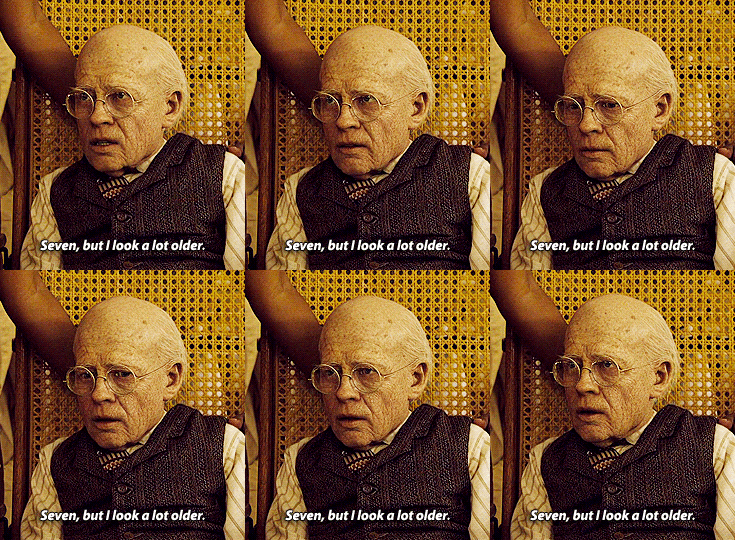
Like Benjamin Button: scientists have managed to reverse the aging process. Will we soon be able to be young, beautiful and healthy forever?

Although from a purely objective point of view it could be argued that ageing is an inevitable and irreversible process, like everything that accompanies it, science takes a different view. That is, at least with regard to recent experimental research - according to its results, ageing is a process whose phases are freely interchangeable and variable. "Experiments show that ageing is a reversible process that can be driven not only forward but also backwards," said genetics professor David Sinclair, an expert in the fight against ageing. He has been working on the issue of cellular ageing and its causes with his team for 13 long years - and now the results of their many years of joint work have been published.
Science fiction from (scientific) life
Those who are not themselves actively involved in a scientific environment can certainly consider anything to be imaginary science fiction. However, the current claims of the scientists, who are specialists in genetics, do indeed smack a bit of science fiction. Our bodies supposedly contain a kind of "backup copy" of our youth, which can be revived and regenerated. The experiments carried out then completely challenge the widely accepted belief that ageing is the result of genetic mutations that disrupt our DNA. As a result, they actually create harmful "waste" in our bodies that accumulates, builds up, and eventually leads (due to cellular ageing and subsequent cell death) to the development of countless diseases and ultimately to death. "What makes us age is not waste or damage. We believe the cause is a loss of information - the loss of the cell's ability to read its original DNA, so it forgets how to function properly. The principle is similar to how an outdated computer produces corrupted software. I call it the 'information theory of ageing'," Sinclair summarised.


The epigenome is the key factor in all this research. What is it? If we think of DNA as the hardware of every body, epigenomes are certain proteins and chemicals that latch onto each gene and signal it to do what, when and where. So, in simple terms, the epigenome switches genes off and on again - due to a whole range of factors such as exposure to environmental toxins, smoking, chronic lack of sleep, etc. And in much the same way that a computer is gradually damaged, the cellular process is disrupted the more the DNA is disrupted. "The cells panic and the proteins that normally control the genes are so distracted by the need to go repair the DNA. But then they don't all go back to where they 'came from'. So gradually it's like a ping-pong tournament, with all the balls ending up all over the floor," Sinclair also explained, adding that nothing is lost.
In fact, he says, there is a "backup copy of the software" in the body that can be imaginatively reset. This restores the cells' ability to read the genome again as if it were young and intact. "It doesn't matter if the body is 50 or 75 years old, if it is healthy, confused or sick. Once this process is started, the body will then remember how to regenerate and will be young again, even if the person is old and sick. We haven't yet figured out the nature of this body software, but it is already clear that we can use the reset to reverse the body process," the scientist added.
 Zdroj: Giphy
So far, it sounds as if scientists have discovered the real elixir of youth. What's the catch? Well, the research so far has only been done on mice. However, it is in these mice that epigenome modifications have actually succeeded in making their bodies behave like older ones, but also like younger ones. And with that, the signs of ageing disappeared - for example, mice that were blind regained their sight in most cases. Although the research team doesn't yet know exactly how to deliver the necessary "genetic switches" to all the cells to allow the organism to rejuvenate completely, Sinclair says it turned out that even partial rejuvenation in the case of the mice meant an overall extension of their lives. And since the scientists were able to reset the cells repeatedly in specific individuals, it actually implies that even aging can be reversed more than once.
Rejuvenation in 3-2-1
The research team has now progressed to a genetic reset in primates with the testing - but of course, to take the tests further to humans, it may take many decades. Even so, according to another member of the team, Dr Jae-Hyun Yang, all the findings so far will completely change the way we view the ageing process and approach the treatment of age-related diseases. Although we will undoubtedly have to wait a while to reverse ageing, as Sinclair summarises, each person can influence their epigenome by their own behaviour. Indeed, this is evidenced by the fact that people who favour a healthy lifestyle show a lower biological age. So, before we get to the true wonders of science, everyone should bear in mind that how they live their lives definitely matters when it comes to life expectancy...


