
Reward or punishment? How would you feel about the possibility of living your whole life over again? The concept of "eternal return" points the way to fulfilling your being
The afterlife? More like an endless comeback
While "different" doesn't necessarily mean "better," anything that smells of newness usually piques our curiosity, so if there were a chance to be born again, many of us would probably prefer a fresh, completely unique experience rather than a rehash of what we've already lived. In today's fast-paced world, where opportunities literally terrorize us with their cadence, as a plethora of information, opinions, offers, and possibilities are thrown at us daily, the idea of copying our lives "ctrl+c" and "ctrl+v" style into an endless series of repetitions can sound boring, uninteresting, or even scary.
Nietzsche and his "eternal return"
It should also be added that this is not a new idea - Friedrich Nietzsche came up with the concept of the so-called "eternal return" at the end of the 19th century. Specifically, this idea appeared in the "most profound work" the German philosopher ever wrote (in his own opinion), namely the poetic novel Thus Spake Zarathustra.
In this fictional account of the wanderings and teachings of the Persian prophet Zarathustra, when Nietzsche puts forward the idea of an "eternal return", he is essentially speaking of a certain cyclicality of lives, chained endlessly in succession - lives in which every moment, every experience, is repeated again. Every joy and pain, every gain and loss, can thus be relived.


A cycle that governs itself
But let us not imagine that Nietzsche was perhaps ahead of his time in thinking about virtual or otherwise simulated reality, as we know it from the cult films The Matrix or The Truman Show, where the central characters become victims of manipulation as they move through an artificially created world without knowing that someone else is in control.
The famous philosopher did not believe that human destinies are controlled by a "higher power" - he did not assume that some kind of God is watching over us, who pushes individual human beings like pieces on a chessboard and thus "orders" them to play the same game over and over again. Nor did Nietzsche even claim that the "eternal return of the same" described a cosmic order within which an invisible cosmic force should control us all.
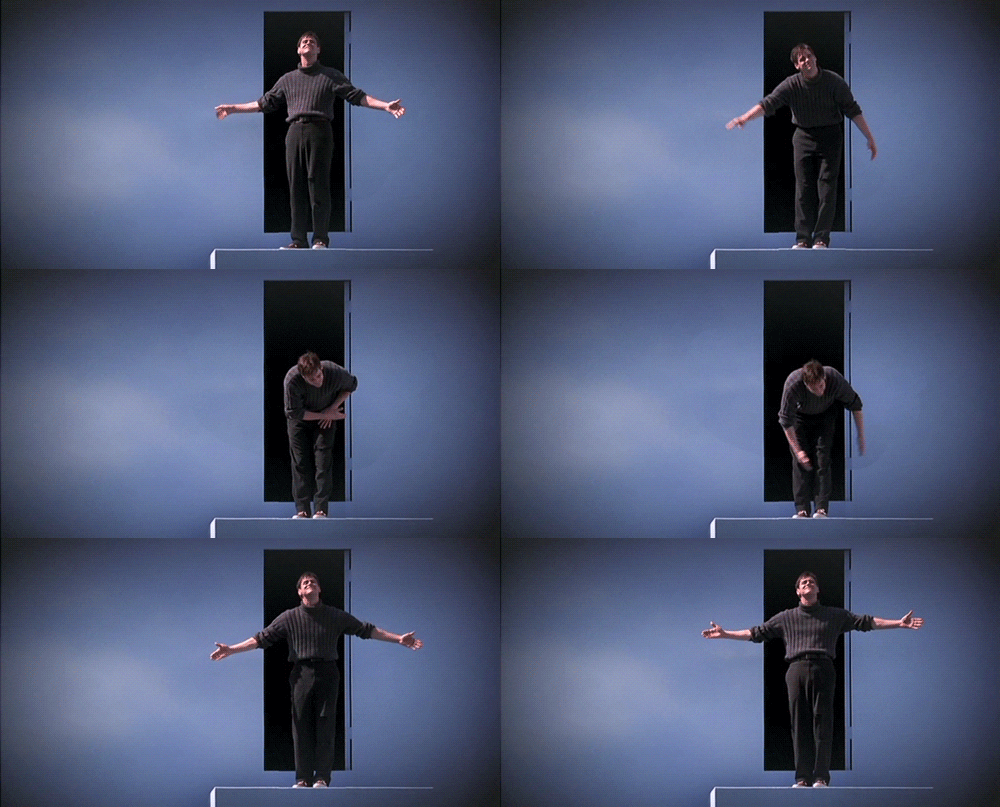 Zdroj: Giphy
You don't want to repeat an inauthentic life
Rather, the concept of "eternal return" addresses a deeper, psychological aspect of the matter - forcing us to seek individual answers to fundamental existential questions. Am I living in such a way that it would be worth "giving" myself all those years again? Twice? A hundred times? Or do I worry that I am not expressing my authentic self very much and that I am holding myself back in many situations? Am I taking responsibility for my actions - for what my life looks like and where it's going? At the same time, can I accept that some of the mistakes, problems and difficulties in human existence are endlessly repeated? That living cannot be honed to perfection because there are downsides to it?
Forget about the "higher powers"
Unlike virtual reality or simulation, where human destinies are changed and controlled by an imaginary "Lord of Destiny," in Nietzsche's concept of eternal "comeback," it makes sense to play a bit of a Creator (or personal coach) yourself. How exactly? You look at your own life from a perspective, as if it were a movie or a video game, and ask yourself: "When this story starts over again after death from chapter one, will it be a welcome comeback for the central character, or more of a nuisance and punishment?"
But even if the famous philosopher is wrong, and you've only had a chance to go through your life "once," the idea of cyclical repetition comes in handy - both as a valuable "reality check" and as a daily motivation not to waste the rest of your days.


